
“Pretty Woman” was one of the biggest films of 1990; it netted over $460 million dollars worldwide, and despite a decidedly mixed reception from critics it still ranks as the highest-rated romantic comedy, based on ticket sales. But if you hang out on boot forums for any period of time, eventually you’ll find someone complaining that this is the film that single-handledly set back the mainstreaming of the over-the-knee boot. An odd reaction by fetishists to a movie whose star, Julia Roberts, spends a good 40 minutes strutting around in black, spike heeled PVC thighboots.

The issue, of course, is that Roberts is playing a Hollywood Boulevard hooker. Her character, Vivian, is a small town girl who has come to L.A. in search of her dreams and ended up a reluctant tart with a heart. In due course, an obscenely rich financial whizz, played by Richard Gere, swoops in at the wheel of a Lotus and rescues her from a life of vice. The film’s message – that money can fix even the most intractable problems (life of prostitution, anyone?) – is a dubious one and from the distance of almost 20 years, it’s hard not to feel a little queasy at the end. You can’t help feeling than Vivian has swapped one kind of servitude for another.

But setting that aside, what about the boots? As we explored in an earlier post, it is true that boots have a historic association with prostitution and it wasn’t until the sixties that they began to gain some respectability. Even then, the acceptance wasn’t universal – in 1968, 75% of office managers surveyed by the New York Times disapproved of their female staff wearing boots to work. But by the seventies boots were totally and 100% mainstream straight wear.

The over-the-knee boot is probably the most challenging style of fashion boot and it took a little longer to get around the whole dominatrix angle. As we’ve already discussed, the shiny latex thighboots of the late sixties were immediately co-opted for pin-up photos in magazines like Fiesta, and even the relatively sober designs of the late seventies, which evolved from the ubiquitous Cossack Boot, had a whiff of punk and rock-n-roll brimstone about them. But by the mid 1980s, a new, softer thigh boot, low-heeled and made from suede, was beginning to gain traction. As I recall (dimly) there was cautious optimism that the ultra-tall boot had finally cracked it.

Then along came Pretty Woman, with its iconic credits sequence of Vivian dressing for a night on the streets to the sounds of Iggy Pop’s Real Wild Child. As she pulls up the zipper on her shiny, spiky boots (the fastener replaced by a safety pin – very punk) you’re left in no doubt that her footwear is an integral part of her hooker persona, along with her blonde “Carol Channing” wig and her spandex micro-skirt. That impression is well-and-truly confirmed when it emerges later, during pre-coital negotiations with Gere, that she stashes her supply of condoms in the top of her boot.
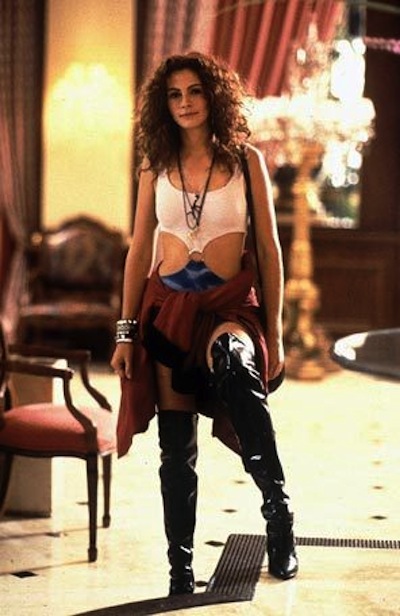
So, is the Vivian effect real? It’s hard to say, but there are certain indications that suggest it might be. The rugged, low-heeled over-the-knee boots of the early 1990s were almost indistinguishable from the very successful styles that have been around for the last 3 or 4 years, but the nineties versions struggled to gain traction in the marketplace and by the middle of the decade they had pretty much disappeared. Although their were sporadic attempts to relaunch thighboots, notably around the turn of the millennium and in the following decade, it wasn’t until 2009 that they succeeded in breaking into the mainstream.
Even than then, nearly twenty years later, it seemed that no fashion journalist could resist the urge to namecheck the movie, and most articles carried a list of dos and don’ts intended to avoid the dreaded “Vivian” look – low heels, softer materials, muted colors, no bare skin.

There’s a certain irony to Pretty Woman. In a pivotal scene, Roberts sheds her hooker duds in favor of a new designer wardrobe, acquired during a high-octane spending spree in Beverly Hills, funded by Gere’s credit cards. This is the point where the boots disappear from the movie, never to be seen again. The irony, of course, is that at the time she could easily have dropped a couple of thousand bucks on a patent leather pair by Versace that would have looked more-or-less the same, and no-one on Rodeo Drive would have batted an eyelid.
Selected References:
- Coleman, Claire (30 July 2009). “Thigh-high boots are the next big thing – but who will dare to wear them?”. Daily Mail. UK.
- Schiavone, Kristyn (10 March 2011). “How to wear over-the-knee boots”. Chicago Tribune.
Image Sources:
- Pretty Woman poster: tore.royorbison.com
- Screen capture: workitownit.blogspot.com
- Screen capture: rocknbodypoleparties.com
- Screen capture: TheseNews.com
- Screen Capture: The Daily Mail
- Image: Seattle Times
- Versace’s 1991 take on the “hooker boot:” source – unknown


 Made For Walking